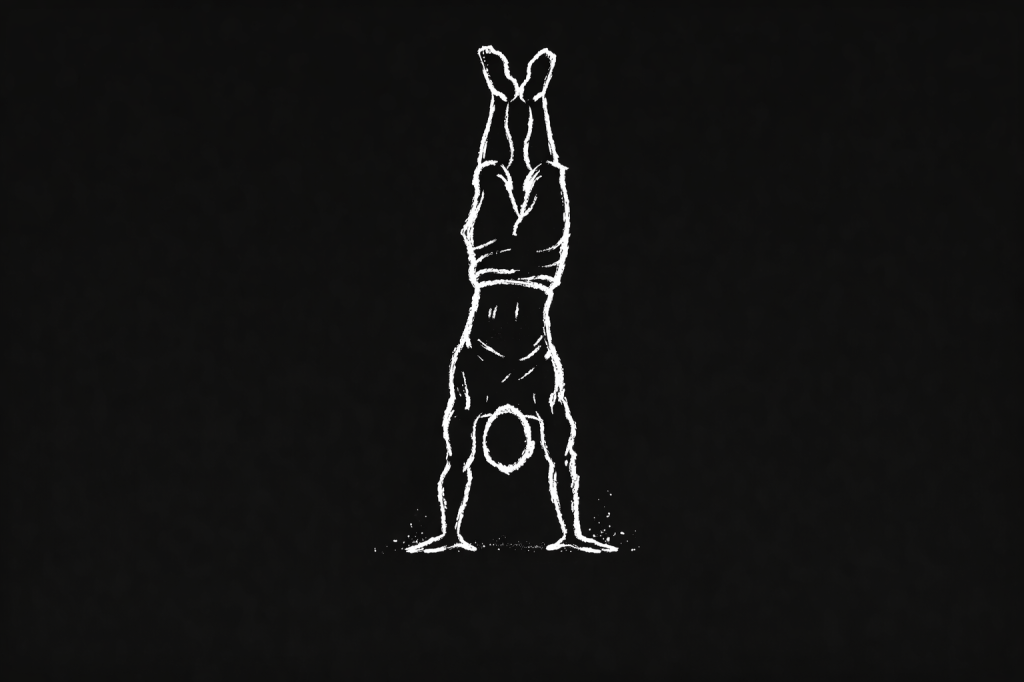
If you know me, you know I love handstands.
I practise them regularly, and that tends to draw attention—especially in a gym setting. It’s not unusual for someone to walk up and ask:
“I want to do a handstand. How do I start?”
It sounds like a simple question. But the real answer is far more complex than most people expect.
To hold a solid 30-second handstand, you need:
- Adequate wrist extension mobility and wrist strength
- Shoulder extension flexibility
- Strong scapular elevation
- A resilient rotator cuff
- Lat strength
- Hip flexor and hamstring flexibility
- Core strength
- Proprioception (the ability to stay calm and controlled while upside down)
Imagine responding with that entire list. It would likely feel overwhelming—maybe even discouraging.
Or worse, it might sound like cocky and arrogant. After all, a handstand is just balancing on your hands… right? What do hamstrings have to do with being upside down?
But here’s the point.
This isn’t really about handstands.
Replace the word “handstand” with your goal.
Maybe you want to run a marathon. That requires structured training, progressive overload, recovery strategies, nutrition planning, hydration, sleep optimisation, pacing, and mental resilience.
Maybe you’re working toward the splits and keep hitting a frustrating plateau after painful sessions.
Whatever the goal, the principle remains the same.
Goals Are Multifactorial
Every meaningful goal is built on smaller, less glamorous milestones.
There is no magic cue, no secret exercise, no viral hack that removes every obstacle overnight. Progress is the accumulation of small adaptations over time. The body needs space to learn, recover, and integrate.
I’ve spent significant time and money searching for “the missing piece” in my own training—only to realise most of it was clever marketing or content designed for engagement rather than long-term development.
Whether your goal is strength-based, skill-based, or endurance-based, one constant remains:
“Time is your greatest ally.”
Stay humble. Stay consistent. Results will follow.
Go Against the Wall
So where do you start with a handstand?
You go to the wall.
You build capacity in a supported position before demanding independence. You identify what you can already do—and you refine it.
The same applies everywhere else.
- Want to run a marathon? Go for a walk first.
- Want to achieve the splits? Start by touching your toes.
- Want to master a complex skill? Master what you can already do first.
For beginners, this is intuitive. You expect to start small.
For intermediates, it’s much harder.
If you’re relatively fit and have been training for years, returning to fundamentals can bruise the ego. In a culture driven by performance metrics and social media highlights, stepping back can feel like failure.
I’ve strained my hamstrings and adductors multiple times chasing the splits after periods of inactivity. My ego couldn’t accept that something which I didn’t even have to think about, now required rebuilding. I tried to skip steps.
And the consequences were waiting for me.
The Ego Trap
Interestingly, beginners often progress faster than those stuck in the intermediate phase.
Beginners don’t skip steps because they’re cautious and afraid. Intermediates skip steps because we’re proud.
It’s like a game of snakes and ladders. Just when you’re one square from the finish line, impatience sends you sliding back to the middle.
Progress doesn’t reward pride. It rewards process.
Whether it’s a handstand, a marathon, the splits, or any other ambition, the formula is the same:
- Break the goal down.
- Start small.
- Respect the timeline.
- Check your ego.
“Master the wall before you leave it.”

 Home
Home 
Leave a comment