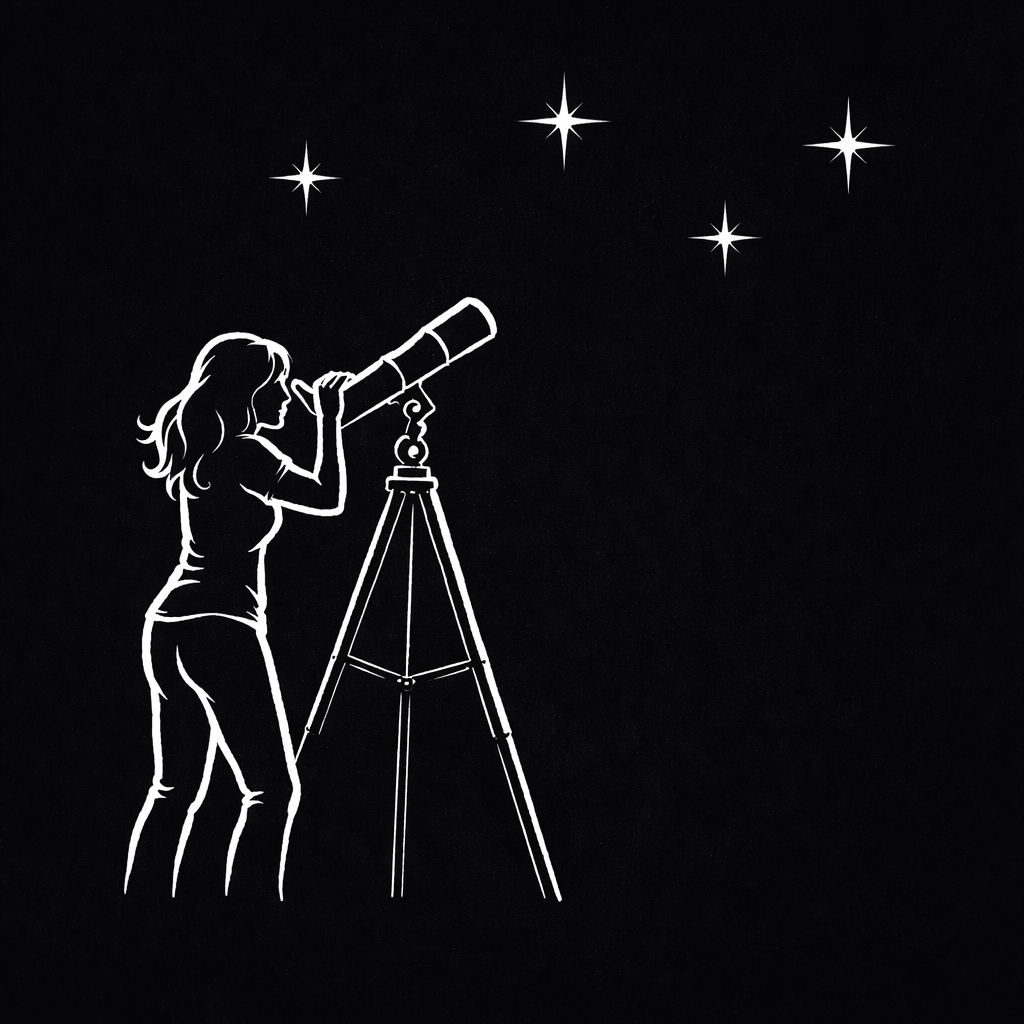
Have you ever heard the name Edwin Hubble? Hubble became known as the astronomer who proved Einstein wrong. In 1924, he discovered that distant nebulae were actually entire galaxies, moving away from the Milky Way — confirming that the universe is expanding, and establishing the foundation of the Big Bang theory. He is celebrated as a pioneer of modern astronomy, and in 1990, a massive telescope bearing his name was placed into orbit around Earth. Hubble was, by every conventional measure, the embodiment of success — a great athlete, strong academic record, a bold character, and a true trailblazer. The kind of person history is built around. The kind of name that gets remembered.
Henrietta Leavitt was another astronomer who lived in the late 1800s and early 1900s. Though “astronomer” is perhaps a generous title for what women were permitted to do at the time. Leavitt worked at the Harvard College Observatory as a “human computer” — one of a group of women hired to analyse photographic plates, compute and catalogue data, and carry out the kind of meticulous, repetitive work that the male astronomers above them considered beneath their time. The pay was twenty five cents an hour. There was no career progression. No recognition. Just the work.
But during that work, Leavitt noticed something that no one else had. Certain stars — called Cepheid variables — pulsed with a brightness that followed a precise and predictable pattern. The longer the pulse, the more intrinsically luminous the star. And if you know how bright something actually is, you can calculate exactly how far away it is. In a single observation, Leavitt had handed science the first reliable ruler for measuring distances across the universe. It was one of the most significant astronomical discoveries ever made — and it came from a woman who was not even allowed to operate a telescope.
Leavitt spent years hoping to see her discovery applied — to visit a telescope and witness the universe first-hand, not just through photographs and data sheets. That request was never granted. She died in 1921, largely unknown outside a small circle of scientists. A few years later, a Swedish mathematician nominated her for the Nobel Prize — only to be informed that the prize could not be awarded posthumously. The committee was unaware she had passed. That is how invisible she had become.
Hubble used Leavitt’s calculations and Cepheid variables directly to make the discoveries that would define his legacy and reshape our understanding of the cosmos. He acknowledged it himself — stating on more than one occasion that Leavitt deserved the Nobel Prize for her contribution. The scientific community largely agreed. But agreement, it turns out, is not the same as action. In the end, it was his name on the space telescope. Her name is on a small crater on the moon — discovered long after her death, by people who finally thought to look.
The Environment You Were Given
We tend to think of our current position in life as a direct consequence of our choices and actions. In many ways, though, that view is incomplete — because one of our greatest advantages or disadvantages is the environment we were born into. We are neither entirely independent of our surroundings, nor entirely defined by them. There is a balance between the two, and recognising both matters.
Take fitness and lifestyle as an example. We often believe that our efforts alone determine how we look and how we feel. But what about the environment you grew up in? If you came from an affluent family with access to sports facilities, nutritious food, and active parents, then movement likely became second nature early on — a game, something enjoyable, something you did without thinking. Tennis lessons on a Saturday, swimming after school, weekend hikes with the family. These aren’t just activities. They are habits being quietly installed into who you are. For someone raised in those conditions, going to the gym as an adult feels like a continuation of an identity they already have. It is familiar. It is comfortable. It doesn’t require willpower — it just requires showing up.
On the contrary, if you grew up in a household where fast food was the default — not out of laziness, but because it was cheap, quick, and the only realistic option after a long day — then nutrition was never something you were taught to think about. If there was no time or money for after-school activities because your parents were working two jobs, then structured exercise was never part of your world. It wasn’t laziness. It wasn’t a lack of discipline. It simply wasn’t there. And the absence of something in childhood has a way of making it feel alien in adulthood. So when the time eventually comes to go to the gym or overhaul your diet, it can feel less like a step forward and more like a war against who you are.
And that’s before we even consider the practical barriers that nobody talks about. Maybe there are five gyms within walking distance of where you live, or maybe the nearest one is an hour’s drive away. Maybe you want to eat better, but healthy food in your area is twice the price of the alternative — and the budget simply doesn’t stretch. Maybe you’ve committed to a new routine, but your kids have snacks everywhere around the house, your partner isn’t on board, and your friends are calling you out for drinks every other night. These aren’t excuses. They are real friction points that make change significantly harder for some people than for others. Two people can have identical levels of motivation and produce completely different results — simply because of the environment they are navigating.
Diet is perhaps where this plays out most visibly. The conversation around eating well has become almost entirely about personal choice — what you decide to put on your plate. But food culture is deeply embedded in family, tradition, and economics. If you grew up eating a certain way, those foods are not just fuel. They are comfort, memory, identity. Asking someone to simply swap those out for brown rice and steamed vegetables is not a nutrition conversation. It is asking them to disconnect from something far more personal than a meal plan. Real change in this area takes time, patience, and an honest understanding of where someone is starting from — not just where you want them to end up.
The Bigger Picture
The point is this: your environment is just as powerful as your willpower. And we haven’t even touched on genetics. We have lived through periods in history where women couldn’t vote, couldn’t work, and weren’t permitted to have a public opinion. People of colour across the world still do not share the equal rights that every human being deserves. Accepting that inequality exists on a macro scale means we must also examine how it plays out on the micro scale — in our daily lives, in our communities, in our ability to pursue our goals.
That is not an invitation to blame everything on circumstance. It is an invitation to be honest — with yourself and with others. Life is multifactorial. Leavitt did the work. Hubble got the telescope. Context matters more than we like to admit.
“We are not independent of what surrounds us — nor are we slaves to it. The truth, as always, lives somewhere in between.”


Leave a comment